
Take5
#Take5 #92 Exploring the Metaverse through Metaphor.
This #Take5 is brought to you from Professor Debbie Holley – Bournemouth University. We have all experienced the pandemic pivot – and now we are engaging with myriad interpretations of a post-digital world. This blog seeks to answer some of our niggling – and some of our deeper questions: what will our teaching and learning look like in the future? Will all the lecturers be in the university teaching students who are all at home? Just how ‘meta’ will our worlds be? With respect to the digital worlds we might inhabit: “The Metaverse is owned by Mark Zuckerman, the founder […]

#Take5 #91 The good, the bad, the sensational of ChatGPT
This #Take5 is brought to you from Dr Katharine Jewitt, Researcher and Associate Lecturer at The Open University and ALDinHE’s wonderful Administrator and Web Developer (AKA Technical Wizard). Artificial Intelligence, and ChatGPT, constitute a phenomenal technological advancement in transforming traditional systems of education, enabling us to radically rethink the way we teach and learn. ChatGPT is driving an education revolution. It’s here to stay but leads to some big questions. This post explains what ChatGPT is and how to use it; what we can do about it, current challenges and potential future applications. Read on to learn more about Chat […]

#Take5 #90 Reflecting through art, culture and practice
This #Take5 is brought to you from Simone Maier. Simone is an inspirational lecturer in the LondonMet School of AAD – art, architecture and design – and is soon to complete an MA in Art Education, Culture and Practice at the Institute of Education (IoE). Working with Simone, we became fascinated by the concept of practice-based research – where the practitioner makes something – anything – as a way of exploring or researching their own theory and practice. This, we thought, was something that every practitioner – every educationist – should think about and get involved with. Read on and […]

#Take5 #89: The Power and Impact of the Student Voice
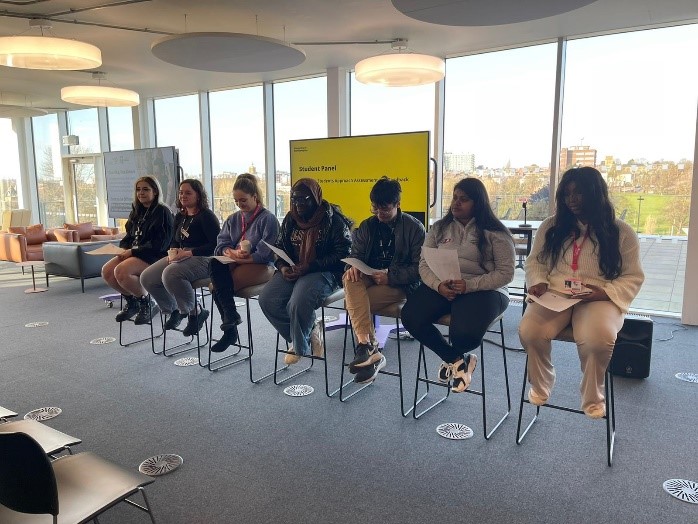
By Kate Coulson – Head of Learning and Teaching Enhancement, University of Northampton “Never work with students”.W.C. Fields (plus a K. V. Coulson embellishment) In my role as Head of Learning and Teaching Enhancement at the University of Northampton, I have a bullet point on my job description that states I must: ‘Lead on the development of mechanisms to enhance student voice involvement as co-creators in learning and teaching’. I have excellent working relationships with our Students Union and their sabbatical officers and take those relationships very seriously: we meet regularly, I support them, they talk to me about concerns […]
#Take5 #88: Sustainable Student Engagement: Get in the (compost) bin!
This #Take5 blog is brought to you from Julie Nolan, Student Engagement Manager | Student Communications Project Manager. Julie is reflecting on work she has undertaken to align sustainability with student engagement activities within Library and Learning Services at Edge Hill University. How can we inform students of our presence and entice them in, in ways that are not wasteful and pointless? Plastic Fantastic Library and Learning Services (LS) at Edge Hill University (EHU) have historically purchased promotional merchandise to give away to students during welcome events, tours, open days and other celebratory activities on campus. Over the years this […]

Take5 #87 Towards a more creative and playful HE
Play provides the energy, the eruptions, the poetry and the connectivity for engagement and success. Play transforms deficit-fixing teaching, it is creative and emergent, it provides spaces and places of reimagining and agency – play has the power to transform education, and educational experiences and outcomes (Sinfield et al., 2019). This #Take5 is brought to you from Sandra Sinfield (London Metropolitan University), Tom Burns (London Metropolitan University) and Sandra Abegglen (University of Calgary). Drawing together playful, arts-based and creative practices, this post offers theoretical arguments for why we all need a more creative Higher Education (HE) to build a more […]

#Take5 #86 Taking Positive Steps for Learning and Teaching: Movement for Learner Developers.
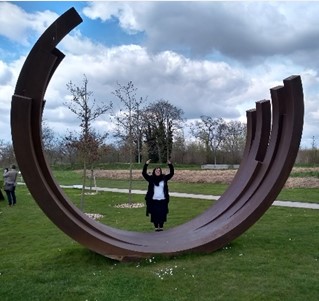
This #Take5 is brought to you from Lisa Clughen, Nottingham Trent University. It is both about the importance of movement in HE – and an invitation to participate in a small research project focussing on qigong-based mindful movement in HE. #Take5 steps? Taking Positive Steps in Learning and Teaching: An Invitation to Participate in Mindful Movement Research. Image: Lisa Clughen doing some Mindful Movement at the Lourve-Lens, France If you could do a very short activity during your working day that, research suggests, could reap wide-ranging rewards for your physical, cognitive and mental health and wellbeing, and in fact for […]
#Take5 #85 What the Learning Developer Did Next
Reflecting on who we are: the evolution and growth of Manchester Met’s Learner Development team This #Take5 blog is brought to you by Avril Buchanan, Chad McDonald, and Kate Haley from the Learning Development team at Manchester Metropolitan University following their recent takeover of ALDinHE’s Twitter account. The post can be seen as a follow up to last week’s #Take5 – which explored finding your feet as a new learning developer. This post constitutes a ‘what the learner developer did next’ – providing some musings on MMU’s LDU’s evolution, how they currently work and why—and as they say: “recognising that […]
Take5 #84 What the Learning Developer needs to know
This #Take5 is brought to you from Joy Igiebor a Learning Development Tutor within the School of Law at Birkbeck, University of London. This is especially for the newbie LDer who feels a bit lost… who thinks that everybody else knows exactly how to ‘do’ Learning Development whilst they alone are thrashing about in the dark. Joy offers very helpful guidelines on workshops and tutorials – a beginner’s guide to Learning Development. Next week we have a post from the team at MMU – what the learning developer needs to know next. A one – two – three of LD I am […]
Take5 #83 The LD Health Hive Mind presents Collaborative Reading Circles
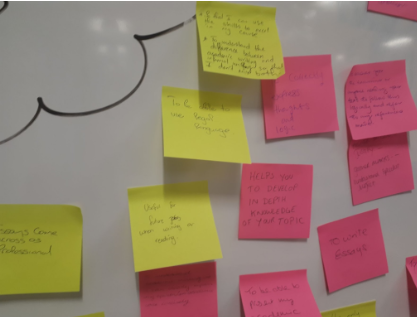
This #Take5 has been brought to you from Tasha Cooper from UWE, Bristol and Anne-Marie Langford from the University of Northampton. In this post, Anne-Marie describes the creation of a brand new ALDinHE community of practice (CoP) focused on Health and Social Care programmes. This CoP is particularly interesting in being online and asynchronous. In this post they focus particularly on the responses curated from a recent community activity that looked at Collaborative Reading Circles. LD Health CoP: Background The LD Health CoP started as a conversation at the ALDinHE conference in June 2022, where I, Anne-Marie, noticed that there were […]